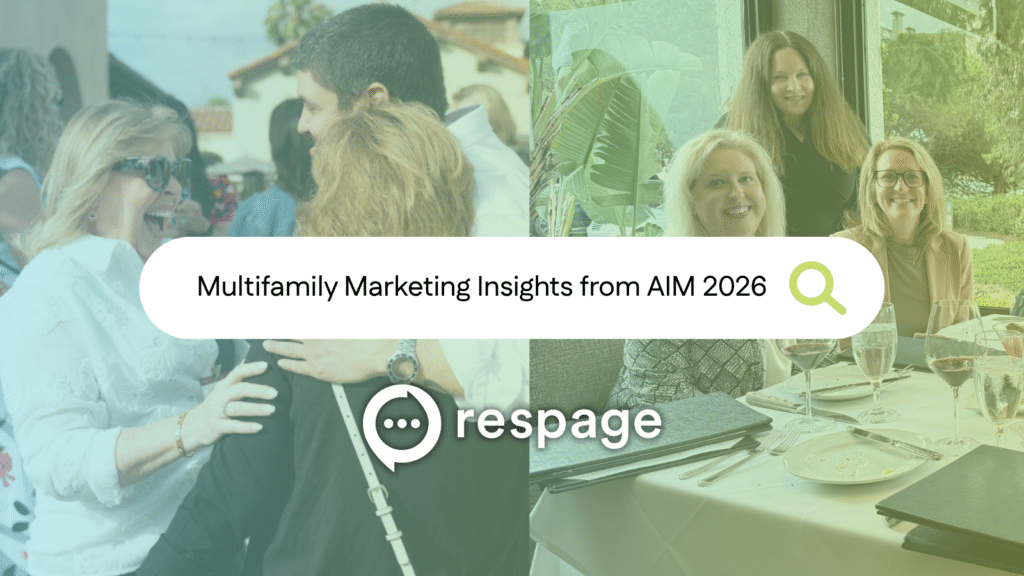
Last week, I attended the 2026 AIM Conference in Huntington Beach, CA. AIM consistently attracts people who are thinking deeply about where apartment marketing and technology are heading, so there were great conversions to be had at every turn.
I left with pages of notes and a lot to think about. This year, there were three themes that stood out to me as the most actionable.
1. Generative Engine Optimization (GEO) and Answer Engine Optimization (AEO)
There was a lot of discussion around GEO and AEO, which are essentially the next evolution of SEO as AI increasingly becomes the layer between prospective renters and websites.
My biggest takeaway confirmed what I already know: most of the tactics are not fundamentally different from good SEO. They are just SEO work on steroids.
The core requirement is still content that needs to be detailed, structured, and useful. One problem that wasn’t discussed at all is that many website platforms in multifamily simply are not built to support enough of it.
One example that came up repeatedly was FAQ content. FAQ sections matter because AI systems rely heavily on clear question-and-answer formats when generating responses. But they don’t work if they are just slapped together.
I recently saw an FAQ for an apartment community that asked: “What are things to do near my apartment community?” The answer listed in its generic response three local employers. I’m a live-to-work girl, but that’s not exactly what I’m thinking when I’m looking for things to do, and it’s a perfect example of what happens when content is produced just to check a box.
This is what happens when you overoptimize. You can use AI to help generate content, but if nobody is paying attention to specifics and engaging the onsite teams for insights, you end up with content that technically “exists” but does not actually help prospects, search engines, or AI systems understand why someone would want to live in your community.
The communities that are going to perform well in GEO and AEO are the ones that create genuinely high-quality, useful, detailed, and locally relevant content consistently and at scale.
2. Reviews Matter for More Than Visibility
Another topic that came up repeatedly was reviews and reputation management.
Reviews now influence GEO and AEO visibility. AI systems are clearly using reputation signals as part of how they determine which communities to recommend. It’s not enough for someone to leave you a positive review. It needs to specifically convey why they recommend your community.
The presenters focused on what I think the industry sometimes misses: the second-order effect. Reviews also influence conversion rates all the way down the funnel.
A prospect may first find your community through AI-generated answers, search, Google Business Profiles, or a traditional Google search. But once they actually start evaluating where to live, most are going to check out your Google Business Profile reviews.
Even if your community enjoys a 4.7 rating, one reference to a poor service experience or rodents is surfaced in AI responses and can impact these conversion rates:
- Website traffic to leads
- Leads to tours
- Tour to application
- Lead to lease
In other words, reviews are no longer just a visibility issue. They are a rent roll issue.
3. Build vs. Buy Multifamily Technology
The final topic I spent a lot of time thinking about was build versus buy when it comes to multifamily technology.
I’m certain we are going to see more companies building internal systems. AI tools and modern development platforms have lowered the barrier to entry dramatically. It didn’t go unnoticed to me that 2 of the 5 startups selected to present were offering solutions to help owners build in-house solutions.
But I also think people who have never built a tech platform underestimate the ongoing cost of ownership.
Building software is not just about getting Version 1.0 live. You need to budget for ongoing management and maintenance, security, training, and continuous feature development, not to mention the cost of LLM usage and maintaining integrations, if applicable.
In practice, that means you really need someone acting as a fractional CTO or AI specialist who owns the system long term.
This becomes especially critical when integrations with property management systems are involved. If a leasing integration breaks, if pricing stops syncing, or if lead flow fails, those are not minor inconveniences. They directly impact operations and revenue. I can tell you from experience that sometimes property management software companies change integrations without providing any real warning.
In those situations, having someone dedicated to your systems matters. You do not want a critical integration sitting in a queue behind ten other clients at an agency or development shop.
That said, I absolutely think there are areas where building internally makes sense. Some operational tools and workflow improvements are easy to build and realistic to maintain.
For example, systematizing the creation of 3D floor plans or automating internal marketing workflows that run when you onboard a new community are great examples of systems that can create real efficiency gains without becoming enterprise-level software projects. The key is understanding the difference between building a helpful tool and building a mission-critical platform.
Final Thought
As always, AIM is the place to be if you want to see the best presentations and engage in the best conversations in the industry. I left with a lot to think about, but also with confidence that the changes we’ve already made to our SEO/AEO, reputation management, and social media management tools have positioned and future-proofed our clients perfectly.
My final thought is for anybody working in multifamily marketing or technology right now. One thing is becoming very clear: the pace of change is still accelerating. The gap between companies that adapt intentionally and companies that don’t is only going to widen from here. Make sure you are on the right side of the chasm.
Categories: