Back to Blogs

June 23, 2026

Multifamily Marketing Trends from Apartmentalize 2026

Multifamily Marketing Trends from Apartmentalize 2026

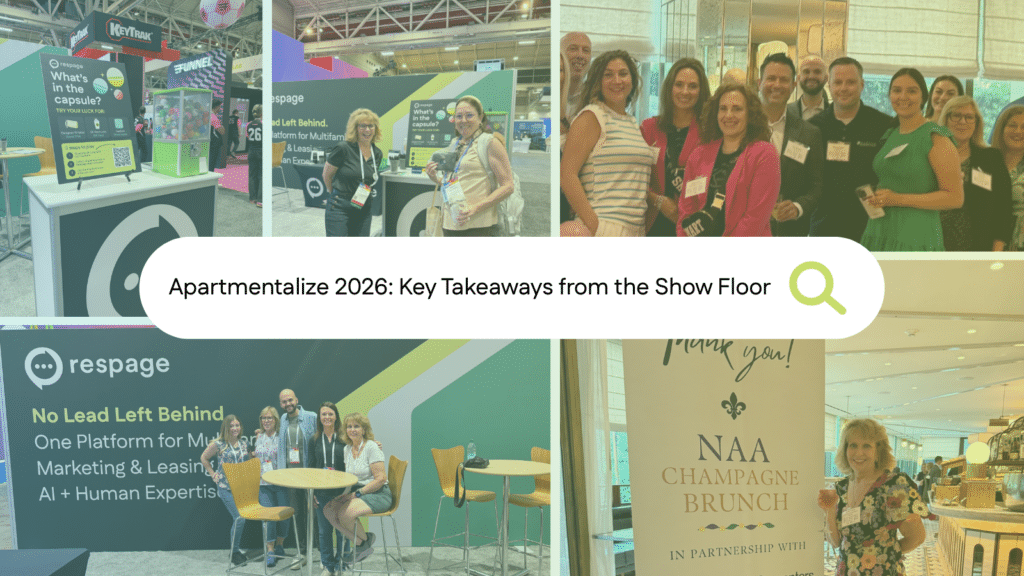
Between the World Cup, flash flood warnings lighting up phones, and at least one tornado alert, multifamily professionals from across the country descended on New Orleans for Apartmentalize 2026. The weather was unpredictable. The energy was anything but.

Apartmentalize remains the industry’s most important gathering for a reason. It is where the people actually running properties, managing portfolios, and making technology decisions come together in the same room. The hallway conversations, the booth visits, the moments between sessions are where you learn what is really happening in this industry.

Our team spent the week at Booth 1206, talking with hundreds of property managers, marketing directors, leasing professionals, and operations leaders. We heard about their challenges, their priorities, and the questions keeping them up at night. Needless to say, a few themes surfaced.

Is Your Community Showing Up in AI Search?


If there was a single topic that captured the attention of operators across the conference, it was AI search visibility.

More renters are turning to tools like ChatGPT and Google’s AI-powered search experiences to research apartments. Instead of clicking through pages of listings, they are asking questions and getting summarized answers. And a growing number of multifamily professionals are realizing their communities may not be part of those answers.

The conversations we had on this topic were telling. Nobody was asking whether AI search matters. They had already accepted that it does. The questions were more urgent than that: How do I make sure my communities are being found? Are we being represented accurately? What do we need to change?

This shift is significant. For years, multifamily marketing has been built around a fairly predictable set of channels: ILSs, Google search, paid ads, social media. AI search introduces a new layer of discoverability that operates differently from all of them. Properties that have strong, accurate, consistent information across the web will be better positioned. Properties that have not thought about this yet are at a growing disadvantage.

The good news is that the fundamentals of digital visibility still matter. Strong local SEO, accurate listings, robust Google Business Profiles, and fresh content all feed into how AI systems understand and present your communities. It is not a completely new playbook. But it does require a more intentional approach.

Reputation Management Is Still Widely Misunderstood


One conversation stood out as a perfect illustration of where the industry is with reputation management.

Several booth visitors came by frustrated. Negative reviews had been posted about their community, and they wanted to know if Respage could remove them. It is an understandable reaction. Nobody wants a bad review sitting on their Google listing.

But here is the reality: review removal is rarely possible, and focusing on it is the wrong instinct. What this conversation revealed, and what we heard echoed across dozens of other discussions, is that a lot of operators are still approaching reputation reactively. Something bad happens, and then they respond. There is no ongoing process, no strategy for building a steady stream of positive reviews, and no system for monitoring what is being said across platforms.

That reactive approach has real consequences. Star ratings influence whether prospects click on your listing in the first place. Response rates and recency factor into how platforms rank your community. And when the only reviews you have are the ones left by unhappy residents, the picture that emerges online does not reflect the experience of living there.

The operators who are winning on reputation are doing something different. They are actively soliciting reviews from satisfied residents as part of a consistent process. They are responding to every review, positive and negative, because they understand that the response is as much for future prospects as it is for the reviewer. They are monitoring across platforms rather than checking in reactively when something goes wrong.

AI Is Everywhere, But Operators Want the Human Element Preserved


AI was, predictably, a dominant topic across the entire conference. Vendors were leading with it. Sessions were devoted to it. It came up in almost every conversation we had.

What surprised us was how relieved operators were to hear about the human side of AI deployment.

Teams are running lean. There is strong interest in using AI to handle lead nurturing, answer prospect questions after hours, and move people through the leasing funnel more efficiently. The efficiency case for AI is not hard to make. Operators get it.

But there is a persistent anxiety underneath all of that enthusiasm. 

  • Where do you start? 
  • How do you train your team? 
  • What guardrails do you need? 
  • What happens when AI says the wrong thing to a prospect? 
  • What does this mean for the people on your leasing team?

The phrase that resonated most throughout the week was simple: human where it matters.

When we explained that Respage’s approach to AI leasing is built around keeping humans in the loop, that AI handles the volume and the speed while your team handles the relationships, the nuance, and the moments that actually close leases, the reaction was almost universally positive. 

The best AI leasing strategy is not one that replaces your team. It is one that gives your team back their time. 

Google Business Profile Is a Portfolio-Wide Problem Nobody Has Fully Solved


Google Business Profile came up constantly, and the conversations revealed a consistent pattern: everyone knows it matters, and almost nobody feels like they have it figured out at scale.

For a single community, managing a GBP is manageable. For a portfolio of 20, 50, or 200 properties, it becomes a different kind of challenge entirely. Keeping information accurate across every location. Making sure reviews are being responded to consistently. Ensuring that onsite teams know what they are supposed to do and are actually doing it. Understanding who owns this at the organizational level.

That last piece is more complicated than it sounds. GBP strategy often falls into a gap between marketing, operations, and onsite teams. Everyone assumes someone else is handling it. Sometimes that is true. Often it is not.

The visibility stakes are high. GBP performance directly affects how your community shows up in local search, how prospects perceive you before they ever visit your website, and how your reputation is presented at the exact moment someone is making a decision. It is also one of the primary ways that AI search tools surface local business information.

Getting this right across a portfolio requires a combination of the right tools, clear internal ownership, and consistent processes at the property level. Operators who are ahead on this are treating GBP with the same seriousness they give to their ILS spend. The ones who are behind are leaving meaningful visibility on the table.


The Bigger Picture


Stepping back from the specific themes, what Apartmentalize 2026 made clear is that multifamily professionals are navigating a moment of genuine complexity. The technology landscape is shifting faster than most teams can absorb. Resident expectations are higher. Marketing channels are evolving. And all of this is happening while teams are stretched thin and under pressure to perform.

What we did not hear at the show was paralysis. The operators and marketers we talked to were actively looking for answers. They were asking good questions, doing real evaluation, and thinking carefully about where to invest their time and budget. That is an encouraging sign for the industry.

The themes that surfaced this week: AI visibility, reputation strategy, the balance of automation and human connection, portfolio-scale marketing operations, are not going away. If anything, they will become more pressing over the next 12 to 18 months. The teams building processes and partnerships around them now will be in a stronger position when the landscape shifts again.

The Final Jazz Note


The conversations at Apartmentalize made one thing clear: multifamily teams continue to face evolving challenges, but they are also finding new opportunities to improve efficiency, resident experiences, and leasing performance.

If any of the topics discussed in this article resonate with your team, we would love to continue the conversation. Connect with us to learn how our marketing, leasing, and reputation management solutions can help support your occupancy and growth goals.

Lauren Hoover

Lauren Hoover

Lauren Hoover is a data-driven, AI-enabled marketer with 7+ years of experience driving growth across fintech, SaaS, and AI organizations. She specializes in developing high-converting, persona-driven content strategies that align closely with sales to accelerate pipeline and revenue. Known for bridging strategy and execution, Lauren brings a results-oriented mindset to every stage of the marketing funnel. She is a 2020 graduate of Penn State Brandywine.

Categories: