Back to Blogs

October 14, 2026

Is Your Apartment Website AI-Ready? A Practical Content Checklist

Featured article image

We hear from our customers all the time that their leasing teams answer the same questions over and over again. How does parking work? What’s the pet fee? What’s the lowest rent for a one-bedroom apartment?

Recently, we hosted a webinar about preparing apartment websites for AI search. We asked our audience, “Are those answers on your website, or does someone have to contact your team to get them?”

Floor plans, availability, and amenities cover some of what renters need to know. But the everyday details matter, too. Someone considering your community may want to know whether there’s guest parking or what fees you have that might not be disclosed online.

Your leasing team knows what people ask. Those conversations are a good place to mine when deciding what to add to your website.

We put together this checklist to help you spot missing information and make your site more useful to renters and easier for AI search tools to understand and reference.

1. Answer the questions your leasing team hears all the time

Start with your team, not a keyword list.

Ask your leasing agents which questions come up on calls, in emails, and during tours. Look for questions that require the same answer over and over.

Does my Golden Retriever meet your weight restrictions? Do you allow 9-month leases? Can I lock in my rent in exchange for a 2-year lease?

Give those answers a visible home on your website. A renter should not have to submit a contact form to learn basic policies, and putting this information online future-proofs you for when people start asking these questions in ChatGPT and Claude!

Don’t overexplain everything. Review the answers with your on-site team first. Then use direct language, helpful headings, and enough detail to answer the question.

2. Make your property essentials easy to find

Check your floor plans, availability, and amenities pages as if you were visiting your property website for the first time.

How easy is it to see what unit types are actually available? Do you describe your amenities or rely too much on photos that AIs may not be able to digest? Make sure the information appears as readable page content.

3. Describe the neighborhood with useful specifics

In the webinar, we discussed renters doing research to find neighborhoods that offer the lifestyle they want first. One example of an actual conversion with an AI focused on finding a walkable, tree-lined neighborhood in Pittsburgh.

That is a different question from “apartments in Pittsburgh.” It needs a more useful answer.

Review your neighborhood content. Name relevant, nearby destinations, and explain their connections to your community. That might include information about transit options, local employers, hospitals, universities, or places your residents turn to for everyday errands.

Our webinar used Shadyside Commons as an example of including local information about Carnegie Mellon and UPMC. The team also discussed checking local content against what the on-site team knows rather than guessing what matters to renters.

Use that same approach. Verify distances, routes, and other details before publishing them. Give renters using your site or AIs enough context to judge whether the location fits their routine.


4. Put policies in plain language

Put all the information someone needs before taking the next step online, including lease terms, qualification requirements, accessibility information, and fees.

Keep all language around fees or policies accurate and easy to follow. Your team should be sure to edit your website whenever a policy changes. Clear information helps prospects get further down the leasing funnel before they tour and helps your leasing agents avoid repeating the same explanation.

5. Check for conflicting information

Your website might list one pet fee while an apartment listing shows another. Your office hours might be current on one ILS and outdated on your Google Business Profile.

In the webinar, we discussed this kind of inconsistency as a problem for AI search. It is also a problem for a renter trying to figure out the actual answer to a question.

Compare your website with your Google Business Profile, apartment listings, and social profiles. Make sure fees, availability, features and amenities, contact information, and policies are the same across your digital footprint.

Choose who owns those updates so you can be sure any updates occur across all channels.

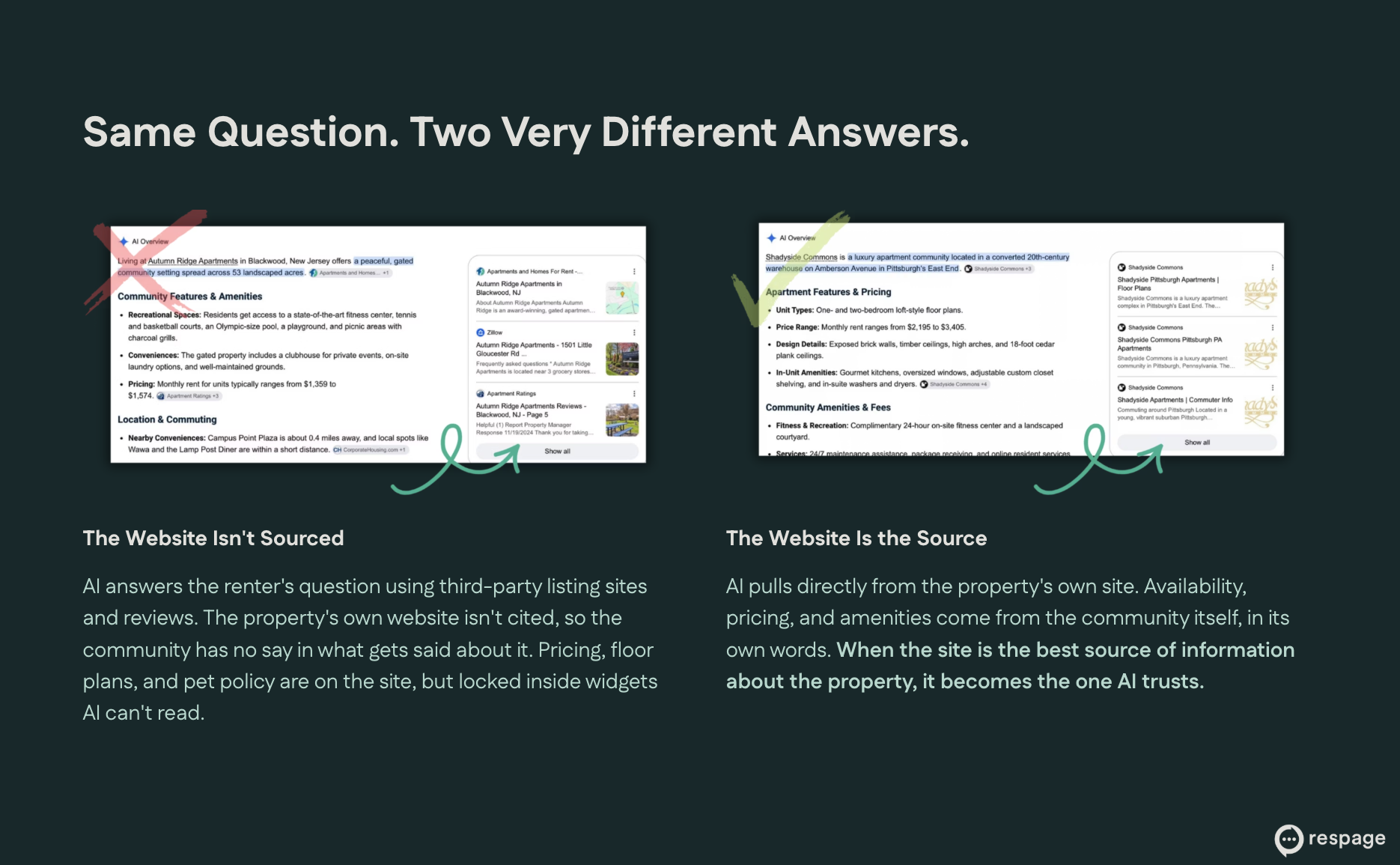
You always want your community website to be the source Google cites in its AI results and be the link they click through to get more information. To achieve this, your site needs to be the authoritative source of information about your community. Otherwise, the AIs will cite Internet Listing Services (ILSs) or other sites where you have even less control over the information. We ran this example during the webinar to show you the difference:

Describe what the image shows

6. Test what AI says about your community

Try this exercise.

“I'm thinking about living at [community name] in [city]. Can you tell me more about living there?”

Look at the answer and any sources it provides. Is your website referenced first? If not, you have some work to do!

Treat the result as a starting point. One answer is just a snapshot. If you run the same query, you will get a completely different answer. Save the prompt and response so you can compare how you appear regularly.

Start with the questions you can answer today

We always like leaving our webinar attendees with something they can do right away. In that spirit, ask your team to identify a few prospect questions they answer again and again and get those questions and answers online.

Want to take things beyond this first step? If you’d like help identifying the gaps, talk to us about reviewing your website's content and AI visibility.

Ellen Thompson

Ellen Thompson

Co-Founder

From the desk of Ellen Thompson, Co-founder of Respage — Since its founding, Respage has helped over 10,000 communities attract, engage, and retain residents. Its platform assists properties in generating leads, automating leasing, and managing reputation and social media. Thompson is also the Founder of Results Repeat, a digital marketing agency that has helped hundreds of companies create a digital presence and use SEO and paid marketing to generate more business online.

Categories: